Most small apartments do not come with a dining room. You get a corner of the living room, a strip beside the kitchen counter, or a space that has to be a workspace by day and a dinner table by night. These small apartment dining area organization ideas help you build an eating space that works without swallowing the room around it.
The challenge with a small dining area is that it is rarely used only for dining. It collects mail, laptops, groceries, and keys, and by dinnertime it needs clearing before anyone can sit down. Solving that means choosing the right furniture, giving the surrounding items proper homes, and building a habit that resets the table daily.
Choose a Table That Matches Your Real Needs
The most consequential decision in a small dining area is the table itself, and most people buy one that is too large. Be honest about how many people eat there on a typical day rather than how many might visit twice a year.
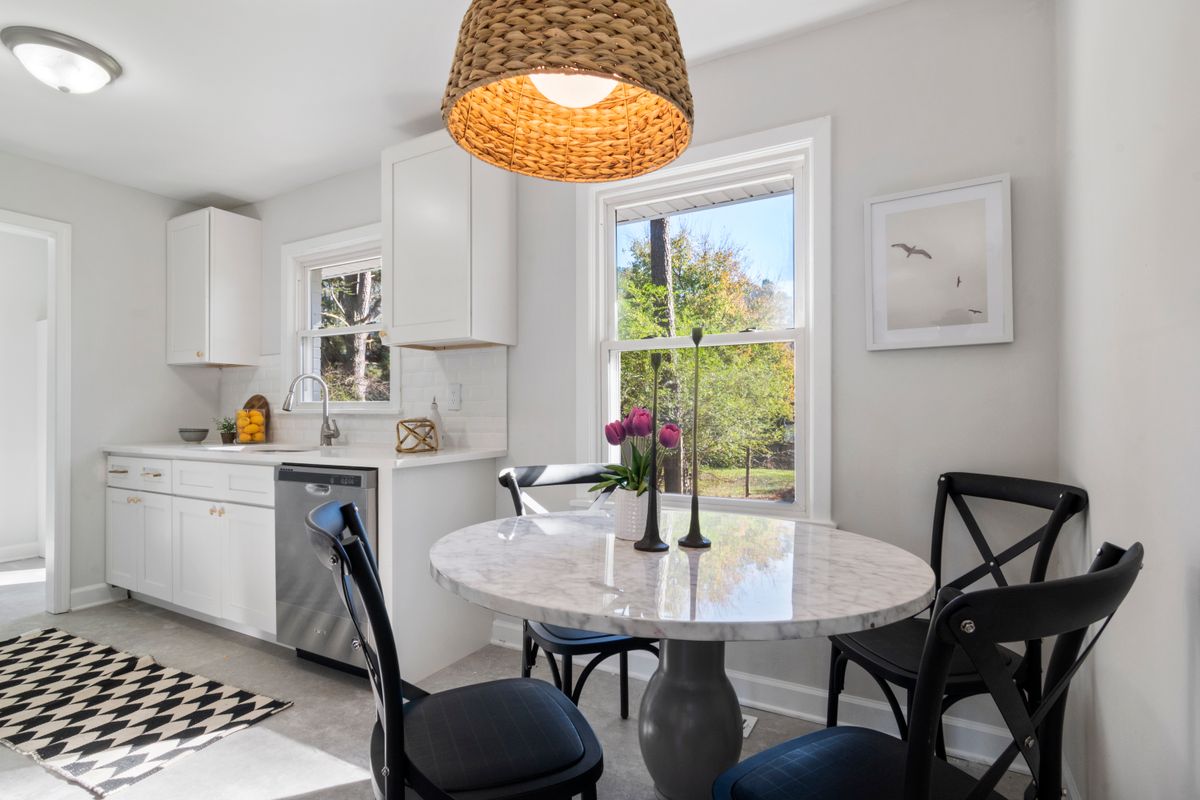
A round table seats more people in less space than a rectangular one of similar area and has no sharp corners to navigate in a tight room. A bistro table for two, a narrow console-height table against a wall, or a drop-leaf table that expands only when needed all serve small apartments far better than a full six-seater.
Measure the clearance around the table before buying. You need roughly 30 inches behind each chair to pull it out and sit comfortably. If that clearance does not exist, the table is too big for the space regardless of how well it fits against the wall.
Use Extendable and Folding Furniture
The best small-apartment dining tables change size. A table that is compact daily and expandable for guests gives you both everyday livability and occasional capacity without permanently sacrificing floor space.
Drop-leaf and gateleg tables fold down to a slim console against the wall and open to seat four or more. Wall-mounted fold-down tables disappear entirely when not in use, which is ideal in a studio where the dining area and walking path are the same square footage.
Pair these with folding or stacking chairs that store flat against a wall, in a closet, or behind a door. Chairs are usually the larger space problem, not the table, because they occupy floor area even when nobody is sitting.
Choose Seating That Stores Something
In a small apartment, every piece of furniture should do more than one job, and dining seating is an easy win.
A storage bench along one side of the table seats two or three people while holding linens, serving pieces, or seasonal items inside. Benches also tuck fully under the table when not in use, which chairs cannot do, freeing the floor completely between meals.
Storage ottomans or stools work similarly as flexible extra seating that holds items inside and moves to the living area when you need it there. Look for pieces with a lift-off or hinged top so the storage is genuinely accessible rather than a chore to open.
Add Vertical Storage Above the Table
The wall above a small dining area is usually empty, and it is the natural place to store the things the dining area actually needs.
Mount a shelf or two above or beside the table to hold everyday dishes, glassware, mugs, or a small plant. Keeping frequently used tableware here rather than in a crowded kitchen cabinet shortens the trip at every meal and relieves pressure on kitchen storage.
A narrow wall-mounted cabinet or a floating shelf with a small lip can hold condiments, napkins, and placemats so the table stays clear between meals. Because these use wall height rather than floor area, they add capacity without shrinking the room.
Give the Table's Usual Clutter a Real Home
A dining table in a small apartment becomes a dumping ground because the items landing on it have nowhere else to go. Fixing the table means fixing what surrounds it.
Identify what actually accumulates there — mail, keys, laptops, bags, chargers — and create a specific home for each nearby. A wall pocket for mail, hooks by the door for bags and keys, and a basket or shelf for the laptop mean each item has a destination that is easier than the table.
This is the single most effective dining area intervention, and it involves no furniture at all. Clutter always flows to the nearest surface with no assigned alternative; give it an alternative and the table stays usable.
Use a Rolling Cart as Flexible Storage
A narrow rolling cart is one of the most useful pieces you can add to a small dining area because it adapts to whatever the space needs at that moment.
Park it beside the table to hold dishes, drinks, and serving items, then roll it out of the way, into the kitchen, or into service as a drinks station when guests come over. Three tiers of storage in a footprint of roughly a foot square is excellent value in a small apartment.
Because it moves, the cart does not permanently commit floor space the way a sideboard does. In a room where the dining area doubles as a walkway or workspace, that mobility matters more than raw capacity.
Define the Zone Without Walls
In an open small apartment, a dining area that is not visually defined tends to blur into the living space and lose its identity, which makes it easier for it to become a storage surface.
Use a small rug under the table, a pendant light above it, or a change in wall color to mark the dining zone. This costs no floor space but signals clearly that the area has a purpose, which psychologically discourages it from becoming a catch-all.
Positioning helps too. Placing the table against a wall or in a corner rather than floating in the middle of the room preserves circulation paths and makes the small apartment feel more organized overall.
Keep Only Daily Tableware Within Reach
Dining storage in small apartments overflows because people keep full sets of dishes for a household size they do not have. Scale your tableware to your actual life.
Keep a daily set sized to the number of people who eat there, plus a modest buffer for guests. Store specialty serving pieces, holiday dishes, and the large platter you use twice a year somewhere less accessible — a high shelf, under the bed, or in a labeled bin.
Choose stackable, nesting dishware so the daily set occupies minimum shelf depth. Uniform plates and bowls stack flush, while a mix of sizes and shapes wastes vertical space in exactly the cabinets that are already tight.
Reset the Table Every Evening
No dining area layout survives without a daily reset, and in a small apartment the reset takes two minutes because the volume of clutter is small if you handle it consistently.
Make clearing the table part of the end of each day: mail to its pocket, laptop to its shelf, dishes to the kitchen, surface wiped. Starting each morning with a clear table means the space is immediately available for whatever it needs to be, whether that is breakfast or a work surface.
With a properly sized table, storage-integrated seating, vertical storage above, real homes for the surrounding clutter, and a short nightly reset, even a corner of a small apartment can function as a genuine, comfortable dining area.